Freeshipping for over $70 purchase

On this page
Key takeawaysWhy Wood Filament Clogging Happens in the First PlaceUpgrading Your 3D Printing Wood NozzleThe Added Benefit of Faster PrintsDialing in Your Wood PLA Settings for SuccessChoosing High-Quality Material: The Ultimate Wood Infused PLA ReviewConclusionFrequently Asked QuestionsShop the nozzle this guide recommendsShop the filamentsKey takeaways
To prevent wood filament clogging, you must upgrade your 3D printer nozzle from the standard 0.4mm size to a larger 0.6mm or 0.8mm nozzle. Because wood infused PLA contains real solid wood fibers that do not melt, these chunks can easily jam a standard hotend. By combining a larger nozzle with high-quality, dry material, you can print flawless, paint-free home decor without mid-print failures.
There is nothing more frustrating than waking up to a failed 3D print. You expect to see a beautiful, rustic tabletop planter on your build plate. Instead, you find your printer nozzle clicking and grinding in mid-air above a messy, half-finished plastic nest.
If you are trying to create beautiful home decors, you want a smooth, paint-free finish every time. You do not want to spend hours unclogging hot plastic from your machine.
Printing with wood filament requires a slightly different approach than standard plastics. By understanding exactly how this material behaves and making one simple hardware swap, you can banish printer jams forever. Here is the highly practical guide to keeping your nozzle clean and your prints flawless.
Why Wood Filament Clogging Happens in the First Place
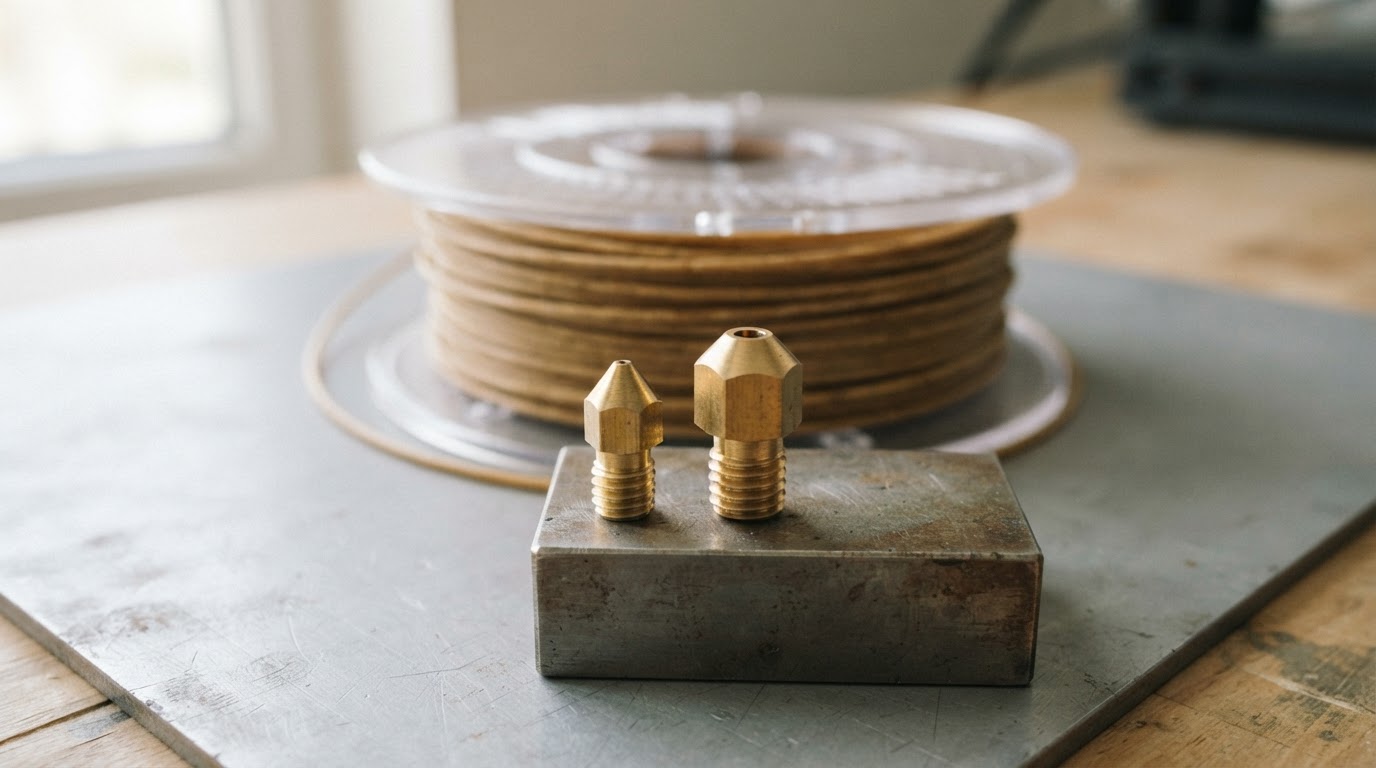
To solve a printer jam, you first need to understand the material. Wood infused pla is a composite material. This means it is a mixture of two completely different things: standard PLA plastic and real, recycled wood dust.
When your 3D printer heats up, the PLA plastic melts into a liquid, just like normal. However, the real wood dust does not melt. It stays completely solid as it travels through your hotend.
- Think of a standard 0.4mm nozzle like a fast-food drinking straw, and wood filament like a chunky fruit smoothie. The liquid plastic base flows through the straw perfectly fine. But the solid wood “fruit chunks” eventually bunch up, instantly blocking the straw and stopping the flow completely.
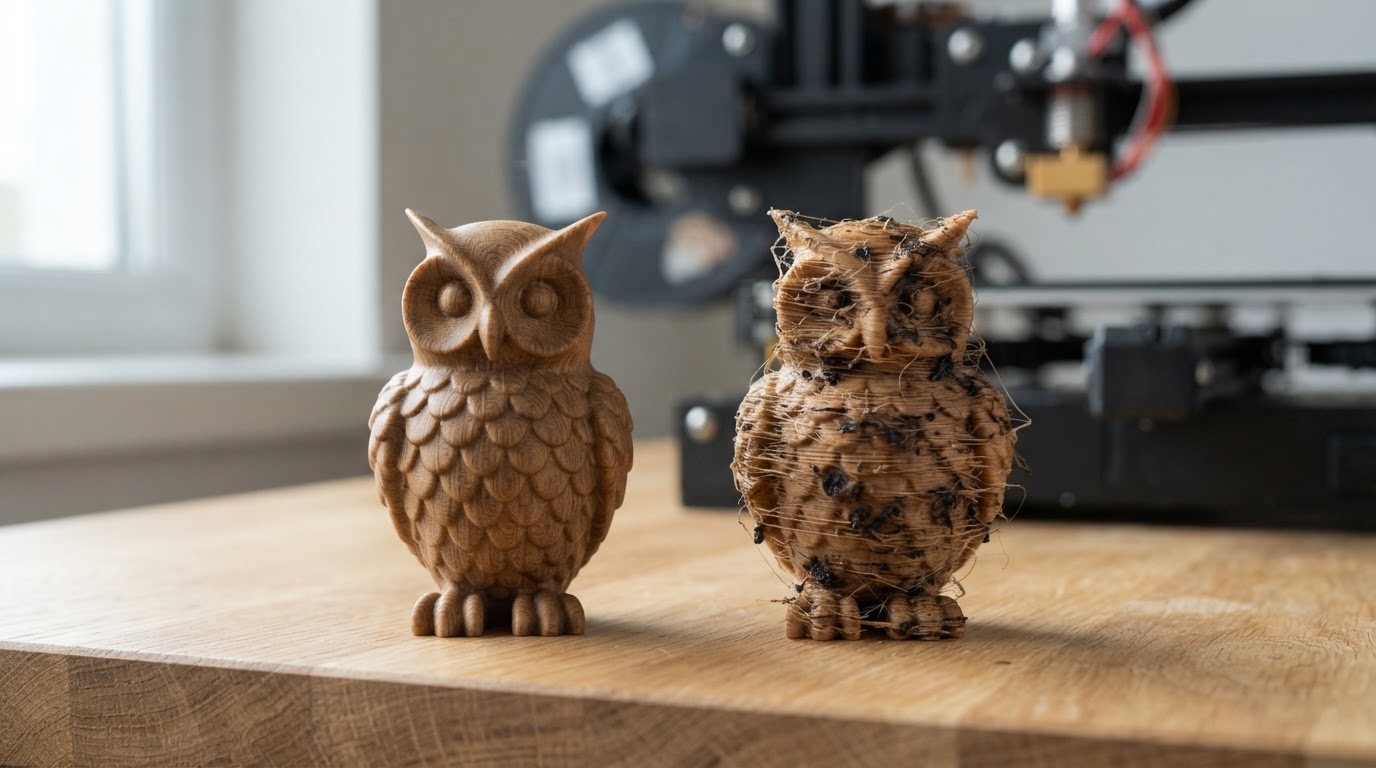
When the solid wood fibers pile up inside the tiny opening of a standard 0.4mm brass nozzle, the pressure builds until the filament gets stuck.
💡 Pro Tip: If you are still deciding if this unique material is right for your next project, read our Honest Wood PLA Review: What to Know Before Purchasing to see exactly what to expect.
Upgrading Your 3D Printing Wood Nozzle
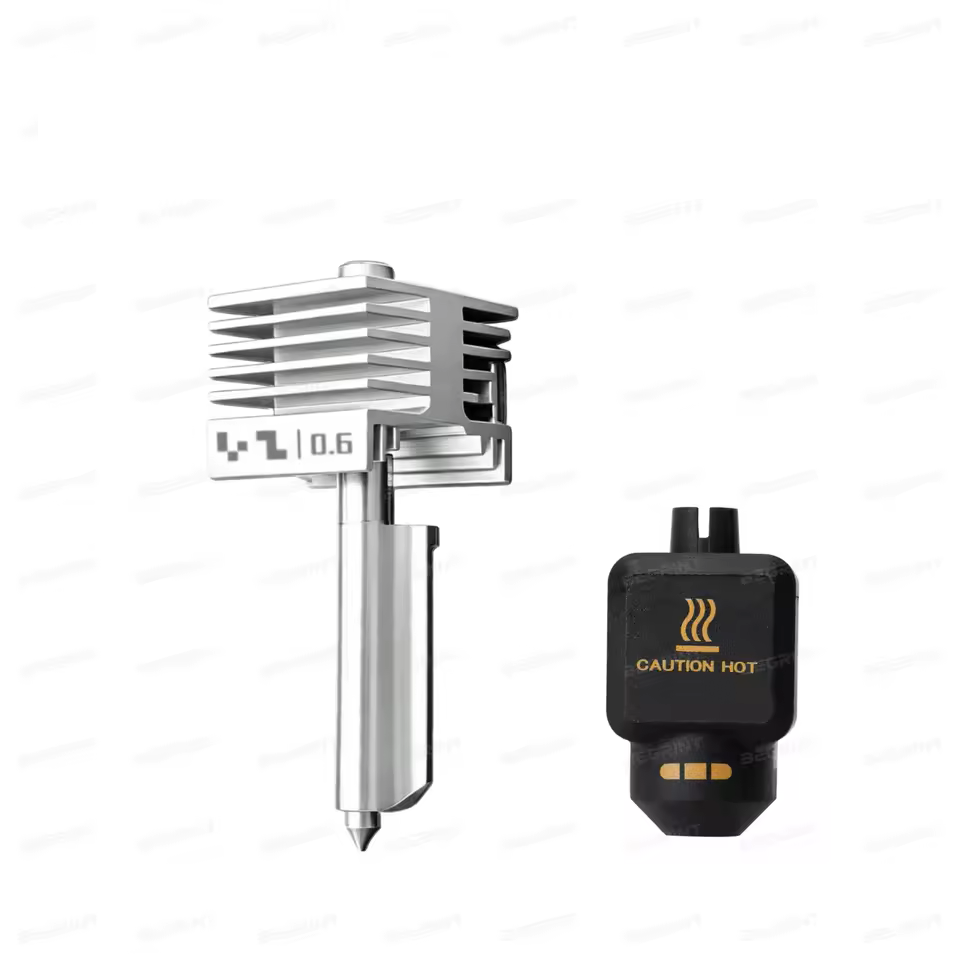
The most effective way to stop clogs is to simply make the exit hole larger. You need to upgrade your 3d printing wood nozzle to a 0.6mm or even a 0.8mm size.
A 0.6mm nozzle is the absolute sweet spot for woodworking prints. It is wide enough to let the solid wood particles pass through without getting stuck. At the same time, it is still small enough to print fine details, like the textured bark on a decorative faux-oak desk clock.
How you swap a nozzle depends on your printer. Some machines use a threaded nozzle and a wrench; quick-swap hotends, like those for the Bambu Lab P2S and X2D, swap tool-free.
The Added Benefit of Faster Prints
Upgrading to a 0.6mm nozzle does more than just prevent jams. It also drastically speeds up your printing time.
Because the hole is wider, your printer pushes out more plastic per second. This means you can print a thick-walled wooden headphone stand in almost half the time it would take with a standard nozzle, with zero risk of clogging.
💡 Pro Tip: Once you have a larger nozzle installed for reliable extrusion, you can start building larger, multi-part furniture. Check out our guide on Designing Functional Joints for 3D Printing Woodworking to ensure your pieces fit together perfectly.
Dialing in Your Wood PLA Settings for Success
Hardware is only half the battle. To guarantee a perfect print, you must adjust your slicer software. Your standard PLA profile will not work well here.
To dial in the best wood pla settings, you need to focus heavily on your retraction distance. Retraction is the setting that pulls the filament backward when the printer moves, preventing stringing.
- Think of retraction like sucking liquid back up into a medicine dropper. If you pull a chunky liquid back and forth too quickly and too often, the solid chunks clump together near the tip. When you lower your retraction distance, you stop dragging the wood fibers back up into the cold part of the printer, preventing those fibers from clumping and jamming.
Practical Settings Checklist:
- Reduce Retraction: Cut your standard retraction distance in half.
- Increase Layer Height: Set your layer height to 0.28mm or 0.32mm. Thicker layers push more material through, keeping the nozzle clear and creating a realistic wood grain texture.
- Print Cooler, Not Hotter: Keep your temperature around 195°C to 205°C. If you print too hot, the wood fibers can actually burn inside the nozzle and turn into hard charcoal blocks.
Choosing High-Quality Material: The Ultimate Wood Infused PLA Review
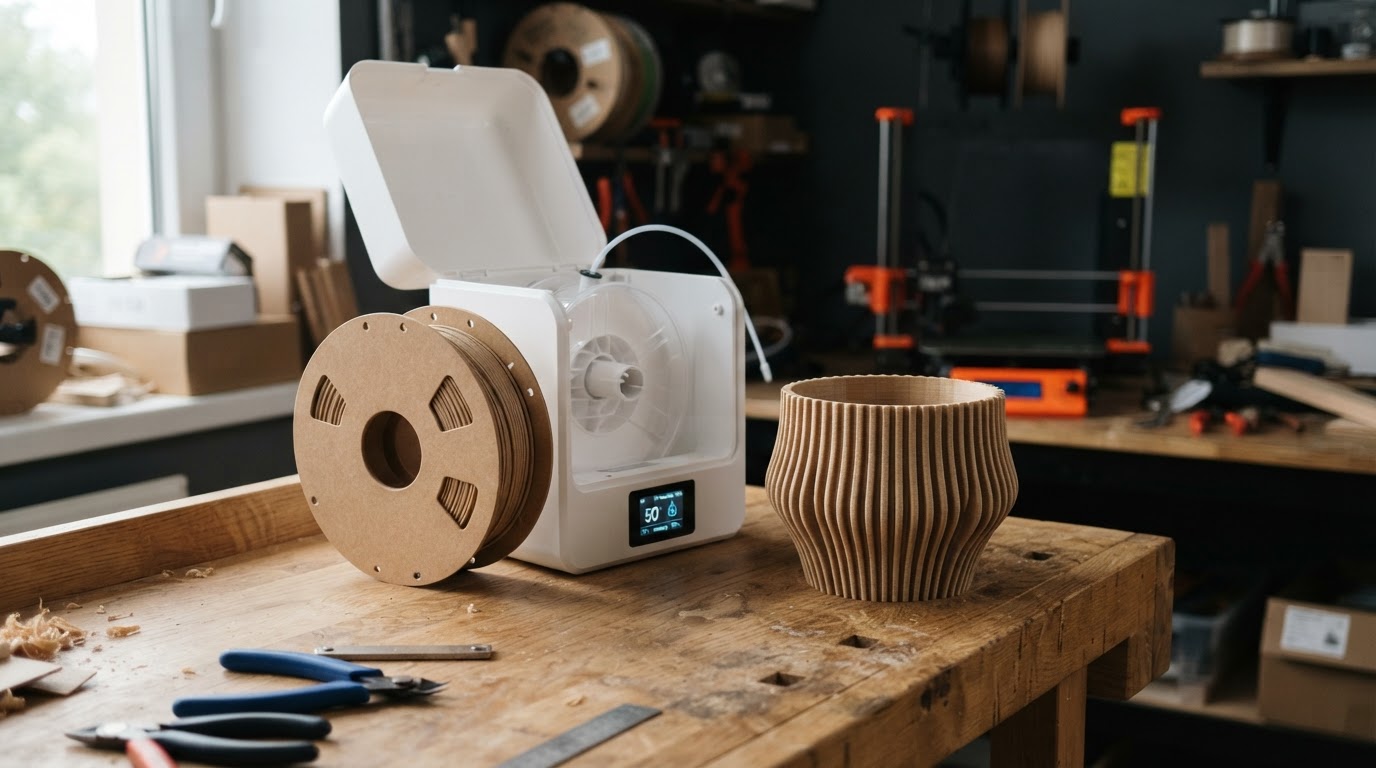
The final piece of the puzzle is the filament itself. A true wood infused pla review will always point out that cheap filament causes the most headaches.
Low-quality brands use large, uneven wood chips and do not filter their material properly. They also fail to dry their filament, meaning it absorbs moisture from the air. Wet wood filament swells up, guaranteeing a clog no matter what nozzle size you use.
- Think of cheap filament like un-sifted baking flour full of hard lumps, while high-quality filament is like finely powdered sugar. The powdered sugar flows effortlessly through any baking sieve, just like finely filtered wood dust flows perfectly through a hot 3D printer nozzle.
To avoid this entirely, always start with professional-grade, dry, finely filtered wood filament.
💡 Pro Tip: After your clog-free print finishes, you can take it to the next level. Learn How to Get the Best Wood PLA Finishing to properly sand and stain your piece.
Conclusion
You do not have to struggle with constant printer jams just to get a beautiful, rustic aesthetic. By swapping to a 0.6mm nozzle, reducing your retraction settings, and using thick layer heights, you can print flawless faux-wood decor every single time.
Remember, the hardware and settings only work if your material is consistent. Choose a dry, well-filtered wood filament from a supplier you trust, pair it with the right nozzle, and you’ll get smooth, clog-free prints.
Frequently Asked Questions
Does Wood PLA actually have wood in it?
Yes, true wood PLA contains real, recycled wood dust or bamboo fibers mixed directly into the plastic base. The mixture is usually about 70% PLA plastic and 30% fine wood powder. This real wood content gives the filament its unique texture, campfire smell, and ability to absorb wood stain.
Is there PLA that looks like wood?
Yes, wood-infused PLA is specifically manufactured to look, feel, and mimic the texture of real wood. It provides a beautiful, textured matte finish that easily hides 3D printed layer lines, making it perfect for printing paint-free home decor.
Is wood PLA stronger than normal PLA?
No, wood PLA is noticeably weaker and much more brittle than standard PLA. Because a large portion of the durable plastic is replaced with soft sawdust, the material loses its structural strength. It should only be used for decorative items, not for mechanical or load-bearing parts.
Is wood filler good for PLA?
Yes, traditional wood filler putty is excellent for post-processing standard PLA prints. You can smear wood filler over a standard plastic print to fill in the layer lines, let it dry, and sand it smooth. Once sanded, the wood filler acts as a great base for painting.
Is PLA Wood good?
PLA wood is a fantastic material if your goal is to create beautiful, realistic, rustic decor without the shiny look of standard plastic. It is highly valued by makers because you can sand and stain it just like real wood. However, it is not good for printing strong, functional tools.
Is 3D printing 40k illegal?
3D printing copyrighted Warhammer 40k models and distributing or selling them is illegal copyright infringement. However, printing custom, original proxy models for your own personal tabletop use at home is generally considered a gray area. It is always best to support original creators and purchase official models or legally licensed 3D files.
Is wood filament PLA or PETG?
The vast majority of wood filament on the market is PLA-based. PLA is the easiest plastic to mix with wood dust because it melts at a lower temperature, which prevents the real wood fibers from burning and scorching inside the hot nozzle.
Can you drink out of 3D printed PLA?
No, you should never drink out of a 3D printed PLA cup. The tiny layer lines in a 3D print create microscopic gaps where bacteria can easily grow, and standard PLA cannot be washed in a dishwasher without melting. To make it food-safe, the print must be coated in a certified food-safe epoxy resin.
Is PLA or PETG better?
Neither is universally better; it depends on your project. PLA is better for highly detailed aesthetic models, home decor, and easy printing because it does not warp. PETG is better for functional, outdoor, or mechanical parts because it is much stronger, more flexible, and highly resistant to heat and UV light.
Ready to print
Shop the nozzle this guide recommends
0.6 mm and 0.8 mm hardened steel, from $21.81. Aftermarket BEGRINT hotend, compatible with Bambu Lab P2S and X2D.
Shop nozzle